ReInvent the Future: Robotic, AI & StartUps at HRW FabLab
Shaping the Future: Reflections by the Founder of the HRW FabLab, Prof. Dr. Michael Schäfer
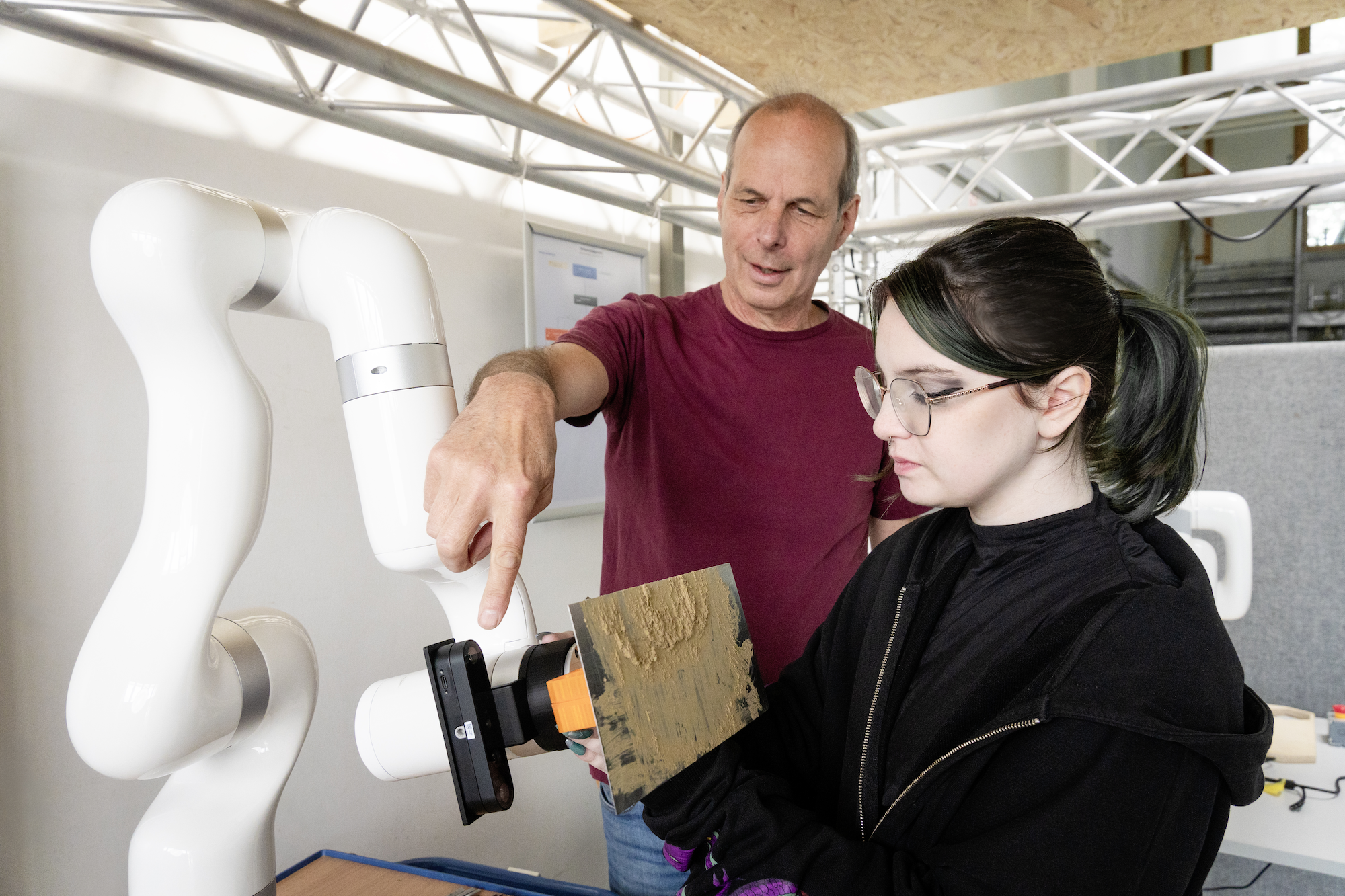
As the founder and director of the HRW FabLab, as well as a professor of computer engineering at HRW, I regularly ask myself: What should we focus on? What are the next emerging technologies? How can we actively shape their development? How can we involve students, researchers, startups, companies, and others? How can we learn together—with enthusiasm, but also through critical reflection?
Take a look where we started
When I started at University of Applied Sciences Ruhr West in 2010 and purchased three 3D printers, a laser cutter and a PCB milling machine as our basic equipment, people laughed at me, saying that these “toys” would never catch on. Today, with our team of 30 employees, we can proudly look back on a 1,000-square-meter innovation space that is likely among the top 10 largest FabLabs in the world (a quick note: there are now around 2,500 FabLabs).
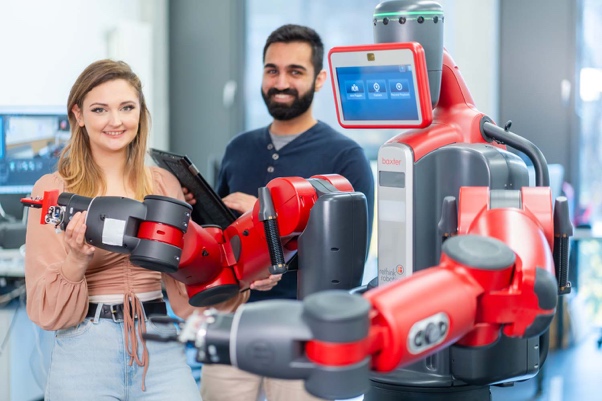
2013: Start der intelligenten Robotik im HRW FabLab
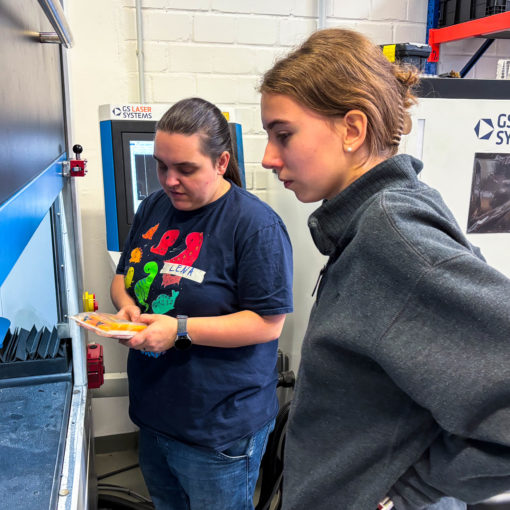
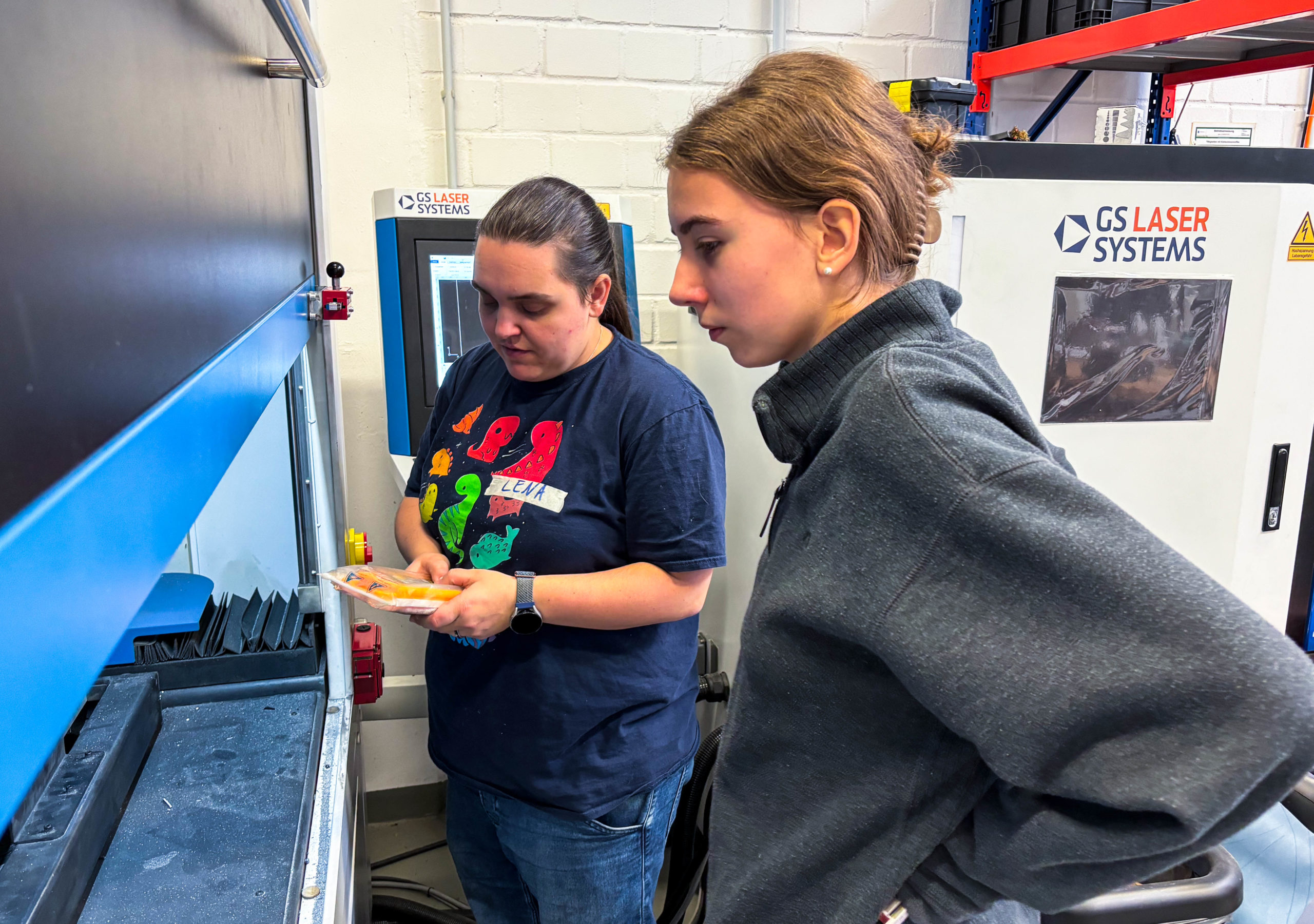
We began exploring human-robot interaction with Baxter from Rething Robotics, one of the world’s first co-working robots. As a student assistant at the FabLab, Lana (on the left in the photo) was still a student in the Human-Technology Interaction program; in the near future, she will complete her Ph.D. in the field of competence development for artificial intelligence (see also :Sattelmaier, L., & Pawlowski, J. (2025). Be AIware! an AI competency model for K-12 education. Social Sciences & Humanities Open, 12, 101838.) It’s especially rewarding to follow these success stories from the FabLab into the students’ professional careers, and above all, to see how their technical skills have developed over the years.
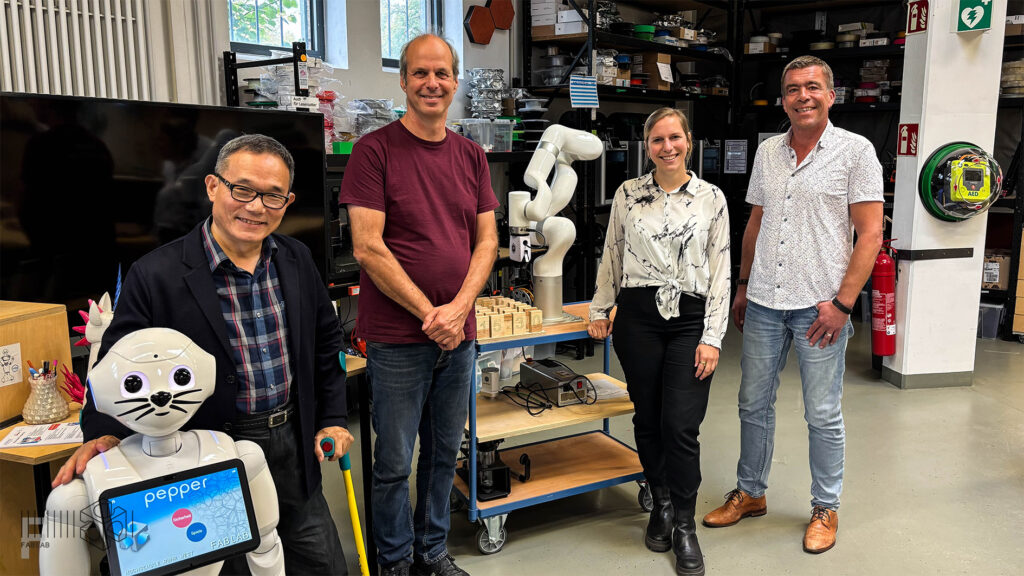
Pepper as a photo prop, a social robot and for laboratory instruction
Anyone who has attended our Open Night knows Pepper. He’s usually the one who gives us the lab safety briefing, explains where the fire extinguishers are located, points out the emergency exits, and much more.
Some of you may also be familiar with the games for people with dementia that have been installed here. Our former colleague Caro, a rehabilitation educator, developed these as part of her bachelor’s thesis, but Pepper is most popular as a photo model (pictured here with Yonggi, on the far left, a colleague from Chungbuk National University in South Korea).
From BOTS2Learn to Morph3DBot4KI
Around 2018 a core group within the team began building robot systems for educational use because the commercially available systems were unsuitable in many respects. The project is now gaining momentum rapidly; we are currently awaiting 10,000 cubes (injection-molded) and, with new project funding, are moving forward with enthusiasm into further development (Morph3DBot4KI – a modular robotics system for the playful teaching of digital and AI skills) and implementation in secondary schools (grades 7–12).
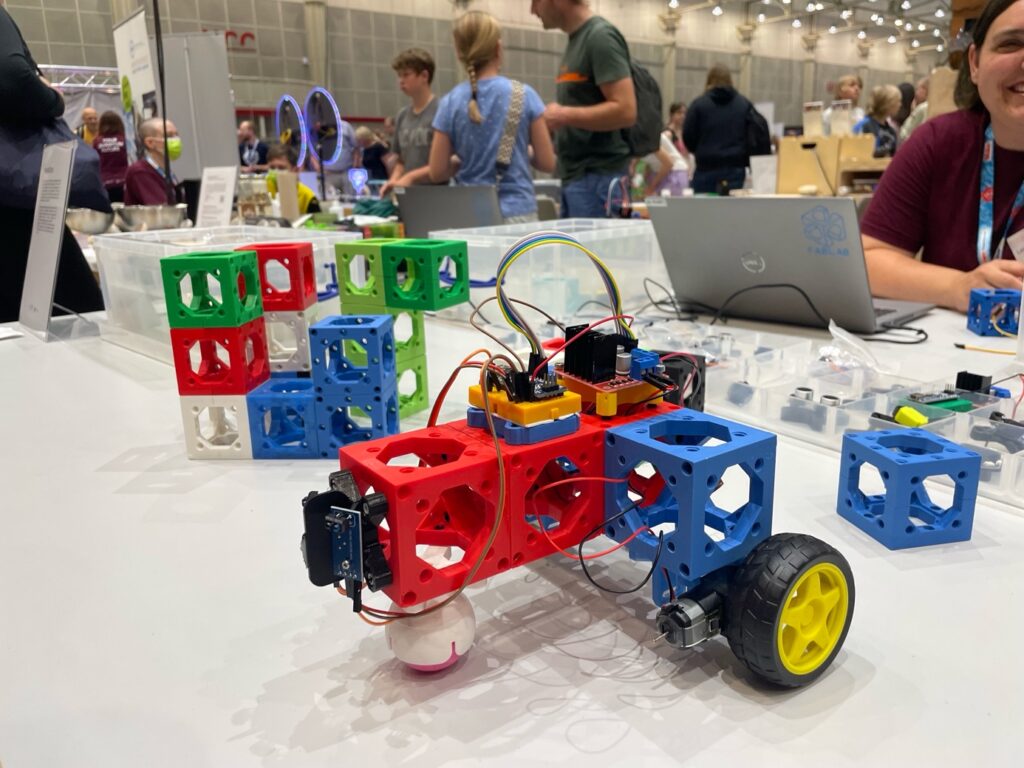
For more information: https://morph3dbot.de/
Examples of AI & robotics startups
The FabLab cooperates closely with HRW StartUps. Many young entrepreneurs are taking advantage of our facilities and expertise to build prototypes and take their first steps toward self-employment. I was particularly impressed by the initiative from Cybrid, which has developed an active exoskeleton. You can see more of them in the promotional video below, starting at 1:24.
The Synergy: HRW StartUps & HRW FabLab
Together, we focus on helping HRW students and staff develop ideas for starting their own businesses and successfully enter the market with those ideas. Below are a few examples from our immediate circle.
More infos: https://www.hrw-startups.de
Arc en Ciel - our AI startup

Arc en Ciel is an AI platform for creators who want to offer their own AI models as professional services. It combines creative freedom with a secure infrastructure, transparency, and tools for hosting, distributing, and monetizing models. This transforms experimental AI projects into scalable offerings for communities and customers. I am absolutely thrilled about the work of Murat and Volkan (both student assistants at the HRW FabLab), who founded the startup.
More infos: https://arcenciel.io/
Renovating an old building: How robots and AI can help
What began as a summer project and expanded into a collaboration with the HRW FabLab will soon become the startup Di’sait A clay plastering robot capable of plastering the ceilings in half-timbered houses:
ntv- Film on YouTube
Quantum Sensing, AI, and the Modular Laboratory of the Future

As a quantum technology FabLab specializing in second-generation quantum sensors, we are pleased that the University of Jena’s spin-off OpenUC2 will soon be setting up a workspace at Prosper III, our location.
University of Applied Sciences Ruhr West (HRW) in Bottrop, through its FabLab, serves as the consortium coordinator for the BMFTR project “Quantum Minilabs” and thus oversees the entire initiative, which brings second-generation quantum sensor technology—such as ODMR on diamonds with NV centers—to up to 100 educational institutions across Germany via affordable, modular experimental kits. Project partners openUC2 provides an open-source optical construction kit consisting of cube-shaped modules (lasers, lenses, electronics), which makes the experiments affordable, robust and reproducible on a large scale. In this way, HRW, together with its partners, enables students to gain a hands-on understanding of how a quantum sensor works.
Marvin Püthe IT - a startup in AI transformation

Marvin Püthe IT Services is an IT services company based in Bottrop that serves small and medium-sized businesses in the Ruhr region. I am happy about the success of our former employee. Under the motto “We’re digitizing the Ruhr region,” the company offers managed services, IT infrastructure, telephony, hardware and software procurement, website solutions, and custom software development—all bundled together in the “IT Flatrate,” among other offerings. The company now also supports its clients in implementing AI and focuses on the effective use of multi-agent systems.
More information: https://www.marvinpuethe.de/
PlantForge – Plant The Future

Plantforge - from an HRW-StartUps idea to the future of farming!
Founded in 2024, the team is developing fully automated indoor farming: smart “Plug & Grow” systems that grow plants without soil or pesticides and using up to 95% less water—regardless of weather or season. Starting with a prototype in 2023, the company rapidly progressed through accelerator programs and initial pilot production to the point of imminent market entry. Learn more at: https://plantforge.de/
plaxite
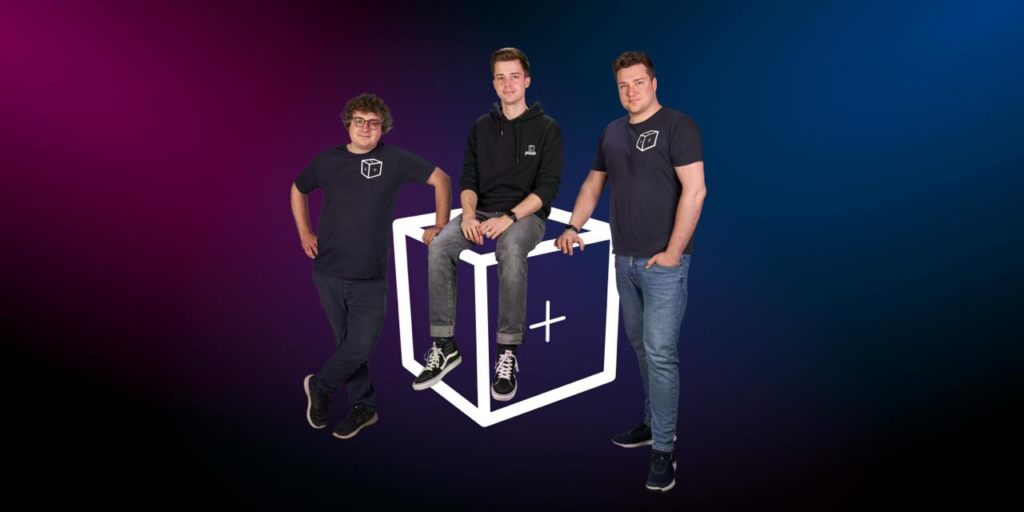
It was actually Julius who asked me if I had a bachelor’s thesis topic for him. I asked him back: “What interests you? What are your hobbies?” He replied with things like amateur theater… interactive stage sets, etc. As a FabLab, we were able to advise the group, and this fascinating development led to plaxite, one of our HRW startups.
plaxite develops immersive, interactive projection solutions that enable companies, museums and event organizers, for example, to present their stories in a striking way and stand out from traditional displays. The team combines projection mapping, creative design, and custom technology to create unique experiences that leave a lasting impression on visitors and stay with them long after the event.
More information: https://plaxite.de/
Founding and pursuing a Ph.D.

The FabLab is a place for experimentation in all areas, especially when it comes to ways of life,
just like Lukas. “An HRW homegrown talent,” he would say. He first earned a bachelor’s degree in mechanical engineering, then a master’s degree in technical production management. He has long been a research assistant at the HRW FabLab, is pursuing his doctorate under Prof. Dr. Jan Pawlowski, and has founded his own company, QRCom.
The research component is then linked to the FabLab or similar innovation environments:
Hellwig, L., Pawlowski, J. M., & Schäfer, M. (2026). Digitalized Innovation Environments as Innovation and Knowledge Transfer Incubators for Companies-an explorative Case Study. International Journal of Innovation and Technology Management.
QRcom helps small and medium-sized businesses strategically plan and effectively implement innovation and digitalization projects. By leveraging the latest scientific and technical expertise, QRcom prepares companies to meet the competitive demands of tomorrow.
More infos: https://qrcom.de/
Unterstützer auf Prosper III
FabLab Bottrop e.V.

FabLab Bottrop e.V. is a nonprofit organization and open workshop in Bottrop that keeps the FabLab concept alive in the region: free, low-barrier access to knowledge and digital fabrication for everyone—based on openness, diversity, and community collaboration. Independently of the HRW FabLab, the focus here is on continuing education and mutual learning, through which people from all backgrounds can network and develop their skills. In this way, the association strengthens the creative and technical potential in the Ruhr region and offers aspiring founders an environment where ideas can become viable startup projects. More at:
Innovation and startup center Bottrop (IGZ)
The Bottrop Innovation and Startup Center (IGZ), located on the former “Prosper III” coal mine site, offers affordable office, workshop, and laboratory space to young companies and entrepreneurs. Effective retroactively as of January 1, 2026, the City of Bottrop has taken over the center from RAG Montan Immobilien in order to permanently secure Prosper III as a hub for innovation, entrepreneurship, and research. Plans call for a new IGZ covering approximately 3,700 square meters, with a focus on urban mining, the green economy, and smart engineering—a clearly defined driver of innovation for sustainable future technologies in the region.
Most of the companies mentioned above will be located onsite.
ReInvent the Future is motto of the Fab26 in Boston, USA, which we’ll be streaming locally here in Bottrop and putting together a special program for everyone who can’t make it to the U.S. If these examples have inspired some of you to start your own projects or develop your own ideas at the HRW FabLab, I’d be delighted.
We continue to create a future for everyone.
Michael Schäfer